 DayWindow
Schengen calculator: the 90/180 rule, counted properly.
Know exactly when you have to leave. Put in the trips you have already taken and it counts them against the rolling 180 days, then gives you the date you must be out by, down to the day. Free, no sign-up, and the sum runs on your own device.
Your trips inside the area
Nothing counted yet
Days used
of 90 in this window
Days left
right now
If you stay from today, leave by
Add a trip
Nothing is counted yet.
Two things almost every calculator gets wrong.
The window ends today, and today is one of the 180. It is not a block that resets on a set date. On any day you are checked, an officer looks back over the previous 180 days and counts. Both the day you arrive and the day you leave count as full days inside.
Staying hands days back. The leave-by date is walked one day at a time, not added on, because while you stay, old days drop out of the back of the window and return to you. Working it out as “today plus the days you have left” gives a date that is too early, sometimes by months.
The EU’s own EES checker may be showing you the wrong number.
Since 10 April 2026 the Entry/Exit System has replaced passport stamps with a digital record, and there is an official tool that tells you how many days you have left. It is worth using. But it carries a warning in its own words, and most people never scroll to it:
“the remaining authorised stay does NOT reflect any time spent in the Schengen area that began before 10 April 2026, regardless of whether the visit ended before or continued after that date.”
In plain words: any trip that started before 10 April 2026 is invisible to it. Because the window looks back 180 days, those older trips can still be counting against you today, and the official number will not include them. That is why people are comparing its answer with what the border desk tells them and getting two different figures.
This page has the opposite problem and the opposite fix: it knows nothing about you, so you type your trips in, and every one of them counts, before or after April. Use the official tool for what the system has on record, and use this to check it against the trips you actually took. The official EES checker is here.
A worked example, because the sum surprises people.
Say you were in Spain from 1 March to 15 April 2026 — a 46-day trip. Check it on 9 August 2026 and the window reaches back to 11 February, so all 46 of those days still count against you. You have 44 days left, which is exactly what a simple subtraction gives. Nothing has come back yet.
And that is where the sum surprises people. If that traveller flew back on 9 August and simply stayed, the date they would have to leave is 6 November 2026 — 90 days, not the 44 they have left today. The extra weeks appear because while you sit there, the March and April days keep falling out of the back of the window and coming back to you, one a day. Adding your days left onto today gives an answer that is far too early, and it is the mistake almost every rough calculation makes.
The 90/180 rule, in plain words.
What is the 90/180 day rule?
If you are not an EU or EEA citizen, you may spend at most 90 days inside the Schengen area in any 180 days. It is not 90 days per visit and it is not 90 days per country. it is 90 days across all 29 Schengen countries added together.
Why is it called a rolling window?
The 180 days are not a fixed block that resets on a set date. On any day you are checked, an officer looks back over the previous 180 days and counts the days you were inside. So the window moves with you, one day at a time.
Do the arrival and departure days count?
Yes. Both count as full days inside, even if you landed at midnight and left at dawn. A stay from the 6th to the 19th is counted as 14 days, because both ends are days you were there.
When do my days come back?
A day you spent inside stops counting exactly 180 days after it happened. So days return to you one at a time, in the same order and shape as the trips that used them.
Which countries are in the Schengen area?
There are 29: Austria, Belgium, Bulgaria, Croatia, Czechia, Denmark, Estonia, Finland, France, Germany, Greece, Hungary, Iceland, Italy, Latvia, Liechtenstein, Lithuania, Luxembourg, Malta, the Netherlands, Norway, Poland, Portugal, Romania, Slovakia, Slovenia, Spain, Sweden and Switzerland. Ireland and Cyprus are in the EU but are not in the Schengen area, so days spent there do not count towards your 90.
What happens if I overstay?
It is decided by the border officer, and the outcomes range from a note on your file to a fine or a ban on re-entering. This page counts days so you can avoid finding out; it is not legal advice.
If I leave the Schengen area, do my 90 days reset?
No. Leaving stops the count going up, it does not put it back to 90. Your days return one at a time, each exactly 180 days after it was used. This is the single most common misunderstanding, and it is the one that ends trips at the border.
Do I have to stay away for 90 days before I can go back?
Only if you used all 90 in one run. If you spent 60 days you do not wait 90 to return. You wait until enough old days have dropped out of the window to cover the trip you want. Put your trips in above and the date you can return is worked out for you.
Does Cyprus count towards my 90 days?
No. Cyprus is in the EU but not in the Schengen area, and it runs its own separate 90 days in 180. Ireland is the same. Confusingly, Cyprus does appear in the EU's own Entry/Exit System country list, which is why people get caught out by this one.
Do Bulgaria and Romania count?
Yes, since 1 January 2025, when both became full members of the Schengen area. A lot of pages still say they are outside it. Days you spend there now come out of the same 90.
Does a residence permit or a long-stay visa count towards the 90 days?
Days you spend in the country that issued your permit or long-stay visa do not come out of your 90. Time in the other Schengen countries still does. The EU's own calculator will not accept these stays at all, which is why the sum has to be done by hand.
Does the EES count my days for me now?
It counts what it has recorded since 10 April 2026. Its own page warns that the number it shows does not include any stay that began before that date, so trips from earlier in your rolling window are invisible to it, and it can show you more days than you really have.
Does this page store my trips?
No. The sum runs inside your own browser. There is no account, no cookie, no advert and no tracking, and nothing is sent anywhere. Close the tab and it is gone.
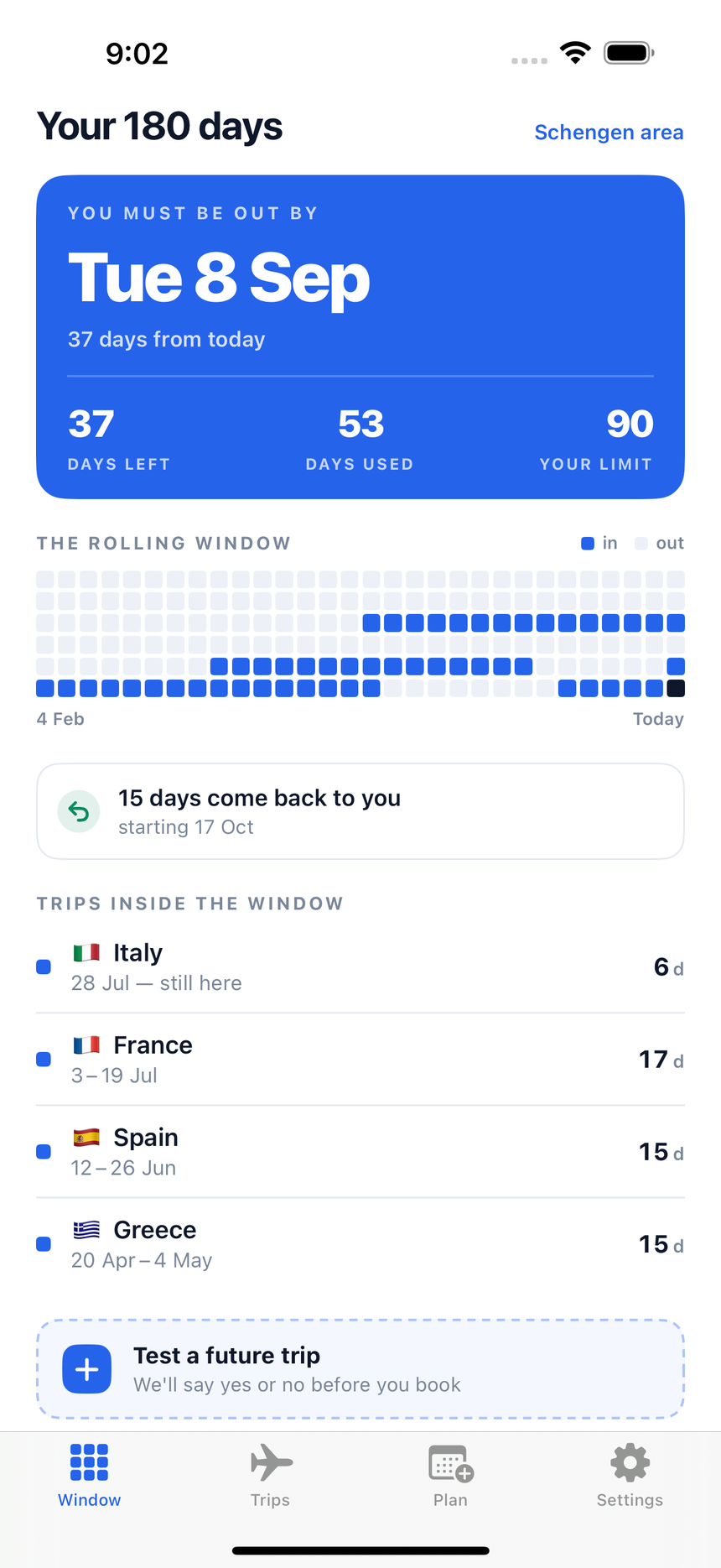
The same counting, on your iPhone.
This page forgets you the moment you close it, which is the point. DayWindow keeps your trips, puts the days you have left on your home screen, and warns you before you are in trouble, using the exact counting you see here.